
After The Diagnosis
The fix, written out in full
The free audit tells you what’s wrong. The Conversion Blueprint drafts the replacement — your homepage copy, your structure, your content plan and your follow-up emails, researched from public conversations in your market — for you to check and personalise.
Worth £6,000–£10,000 to your business
£129
Limited-time offer · going up to £995
one-off · no subscription · no retainer
It’s going up to £995. Right now it’s £129 — a limited-time offer. When it ends, it ends.
Each one is checked and sent personally — in your inbox within 24 hours of payment. There are only so many of those in a week.
You’re not short of visitors. You’re short of conversions.
You know the feeling. The ads are running, the money’s going out, the analytics show people arriving — and the inbox stays quiet. You’ve stared at that dashboard late at night trying to work out what they’re all seeing that makes them leave.
“2000 visitors and 0 sales is a conversion problem not a traffic problem.”
“I’m staring at their website analytics at 2am wondering why people are clicking around but not buying anything — they’ve got traffic but it’s leaking money.”
Every one of those visitors cost you something — ad spend, SEO work, word of mouth. A website that doesn’t convert them isn’t neutral. It’s a hole in the bucket, and more traffic just pours faster.
The Conversion Blueprint plugs the hole: lead generation, conversion copy and SEO architecture built from what your buyers actually say — so the people you’re already paying for start enquiring.
Most website copy is written by guessing
Someone sits down, thinks about what sounds professional, and writes it. That’s how you end up with “delivering high-quality results you can trust” on ten thousand different websites.
I don’t guess. Before I write anything, AI crawlers go through your market: your competitors’ sites, public review platforms, and the online discussions where buyers in your market complain about firms like yours.
What comes back is the actual language. Not “customers value reliability” — the real sentence. On a building firm I audited, the research turned up “he took the deposit, ripped out my kitchen and stopped answering the phone.” That went into their homepage almost word for word.
That sentence is worth more than a month of brainstorming, because it’s the thing your buyer is already thinking when they land on your page. Your job is to answer it in the first screen.
What lands in your inbox
01Market & customer research
Who your buyers actually are, in segments. The three fears that stop them buying. The three outcomes they’re really paying for. The objections they raise, in their words. Where your competitors are weak and where they’re beating you.
02Your homepage, rewritten
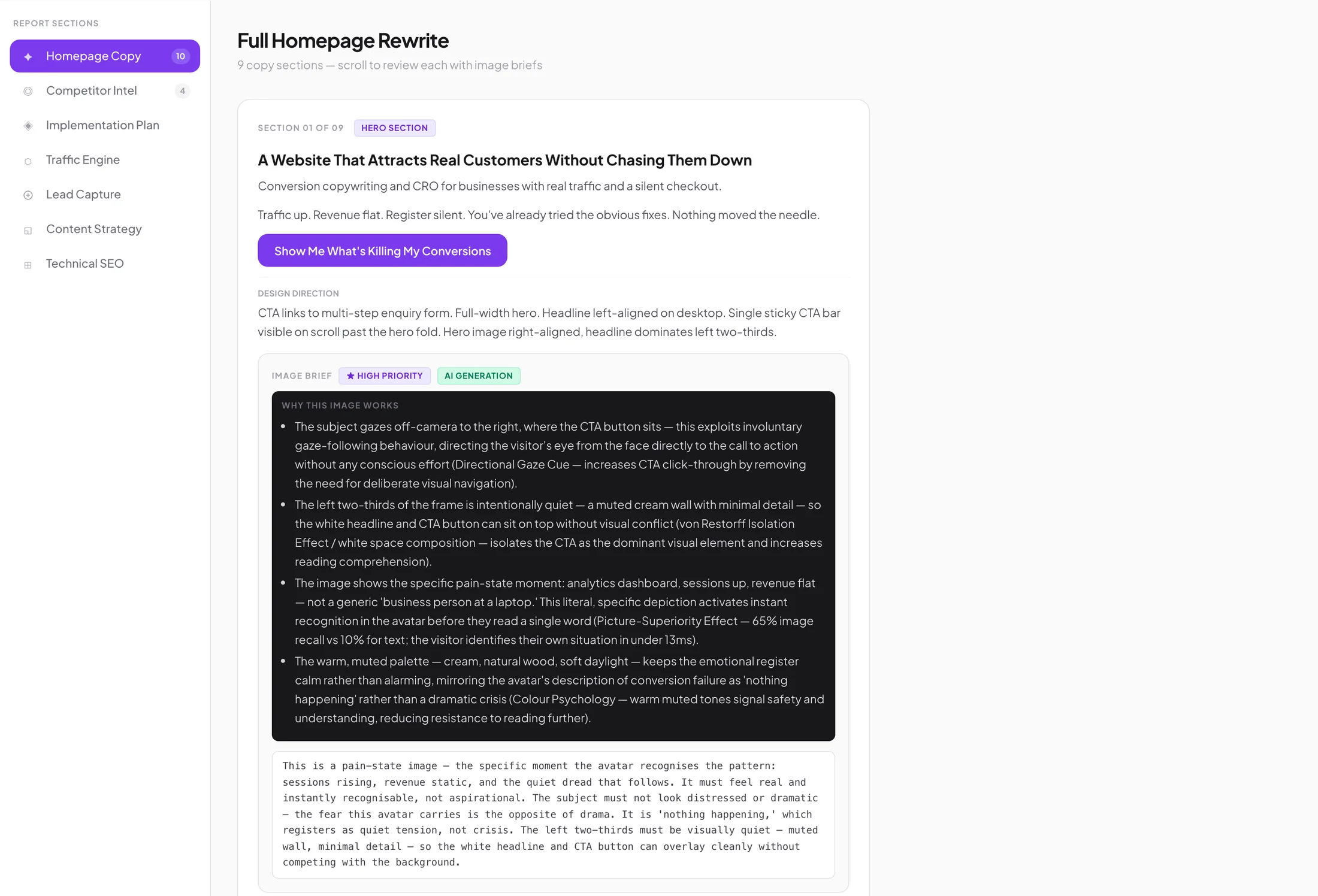
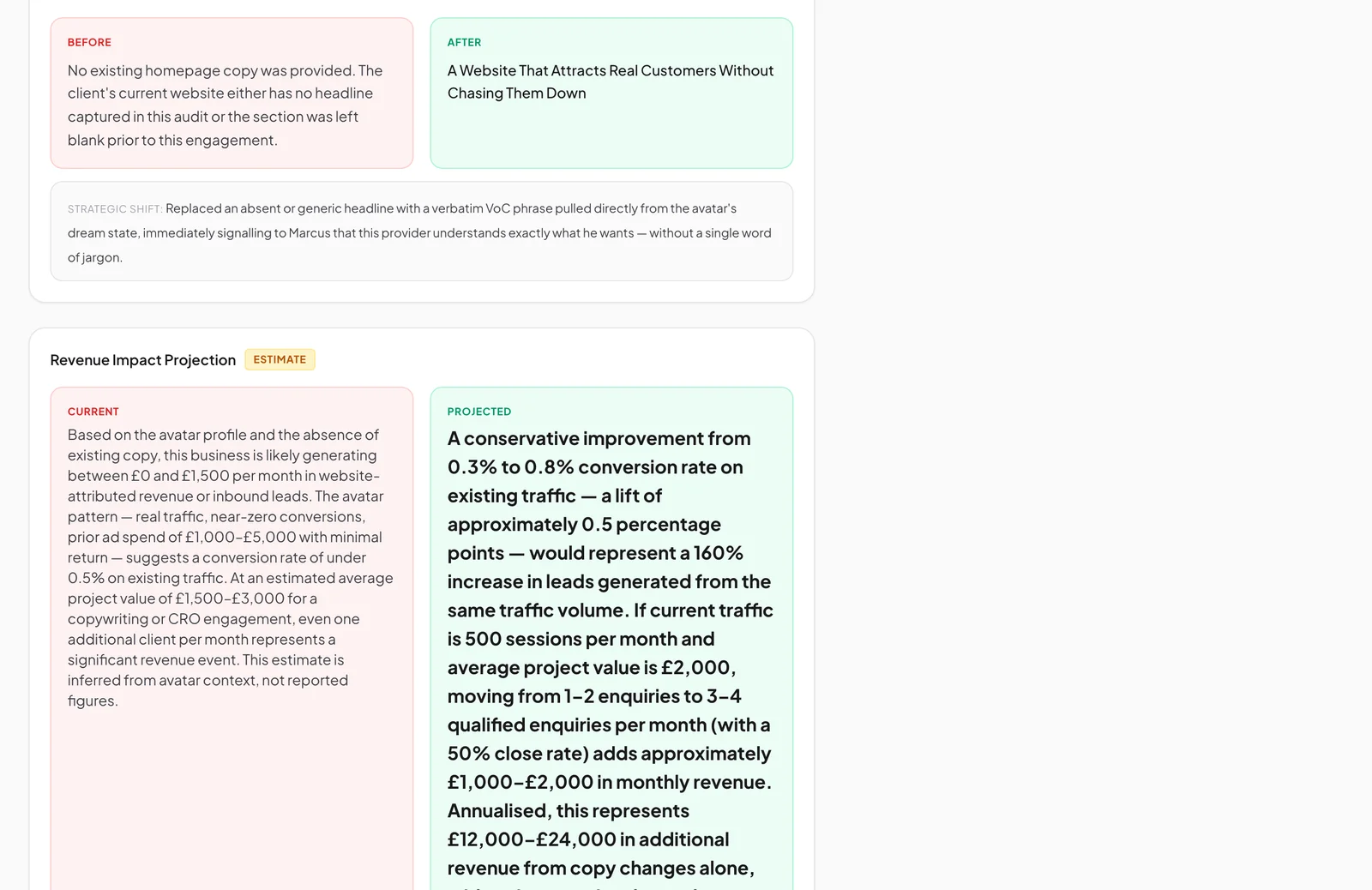
Section by section, top to bottom. Headline, subhead, body, every CTA, every trust element, in order, with a design note for each. Written on the Problem–Agitate–Solution structure, using the language the research surfaced.
03Site structure
Which pages you need, which to delete, what each one is for, what goes on it and in what order. Internal linking. Where the conversion points sit.
04SEO architecture
A meta title and description for your homepage and each suggested page. Heading structure. Schema markup, written out for you to check and add. The keywords worth having, with estimated UK search volumes — and the ones that look good and convert nothing.
05A three-month content plan
Three months of content, mapped to the questions your buyers actually ask: four blog titles and four social themes for each month, plus the supporting pages worth adding. Built so it feeds both search and social.
06A lead magnet and follow-up emails
One lead-magnet idea to capture enquiries you’d otherwise lose, and a three-email follow-up sequence for the people who take it — subject lines, preview text and body copy, written and ready for you to check.
07Google Ads, written
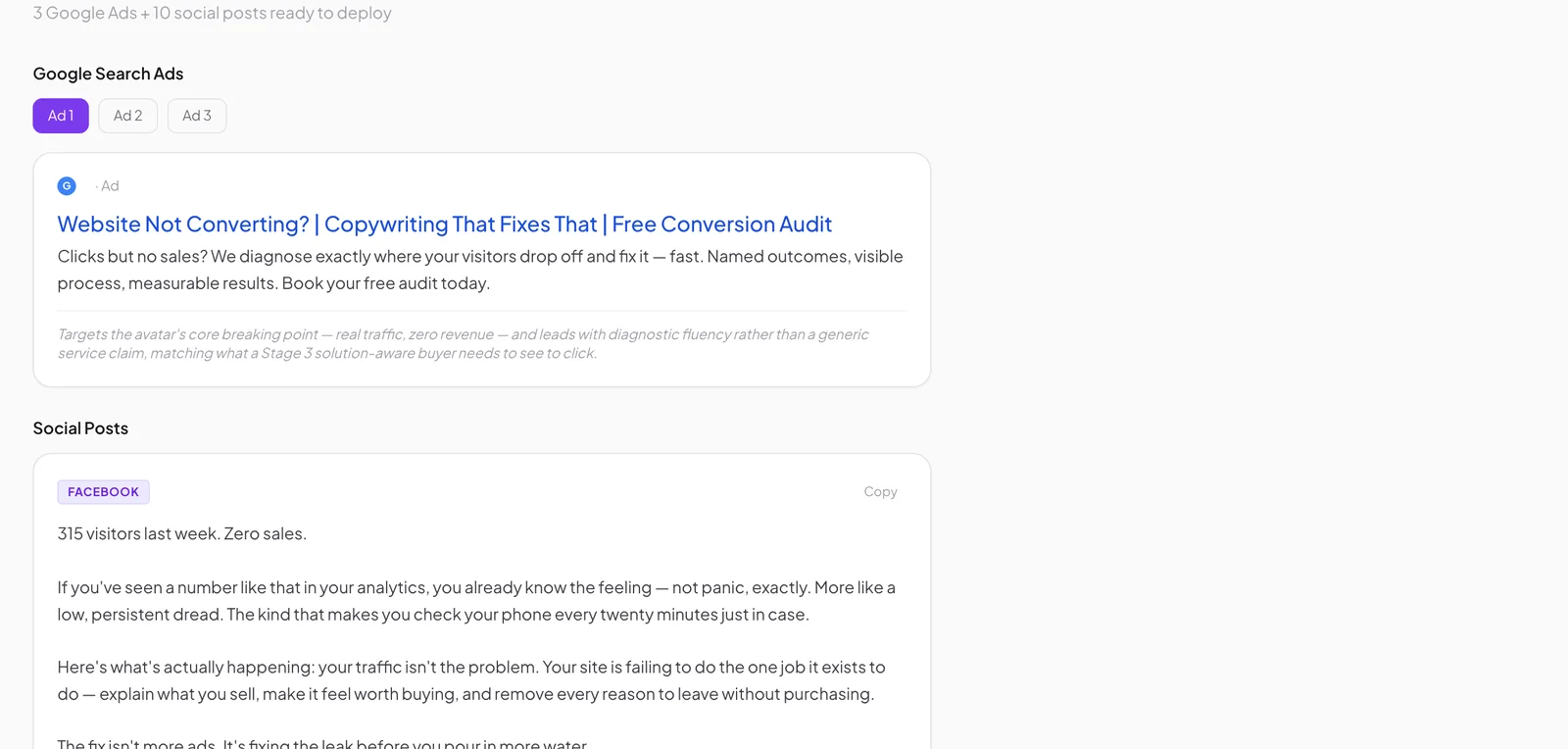
The ad copy, written in your customers’ language — headlines and descriptions written to Google Ads’ length limits — plus the keywords to run them against, pulled from real UK search data. No media-buying jargon, no retainer: the ads themselves, drafted for you to check.
This is the actual document
Not a slide deck. Not a score out of 100 and a handshake. These are screenshots from a real Conversion Blueprint — the one this method wrote for the site you’re reading now. Yours looks like this, about your business.
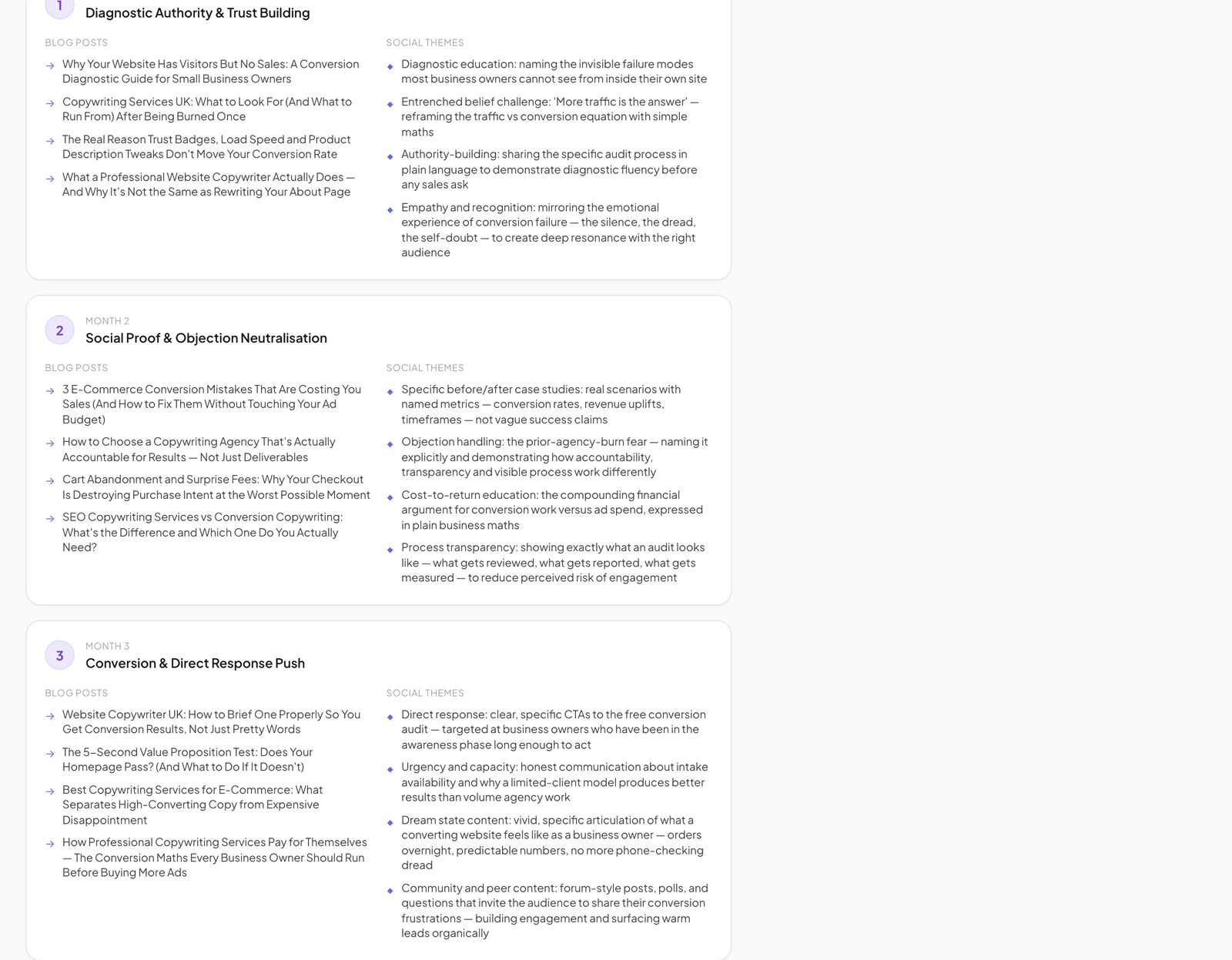
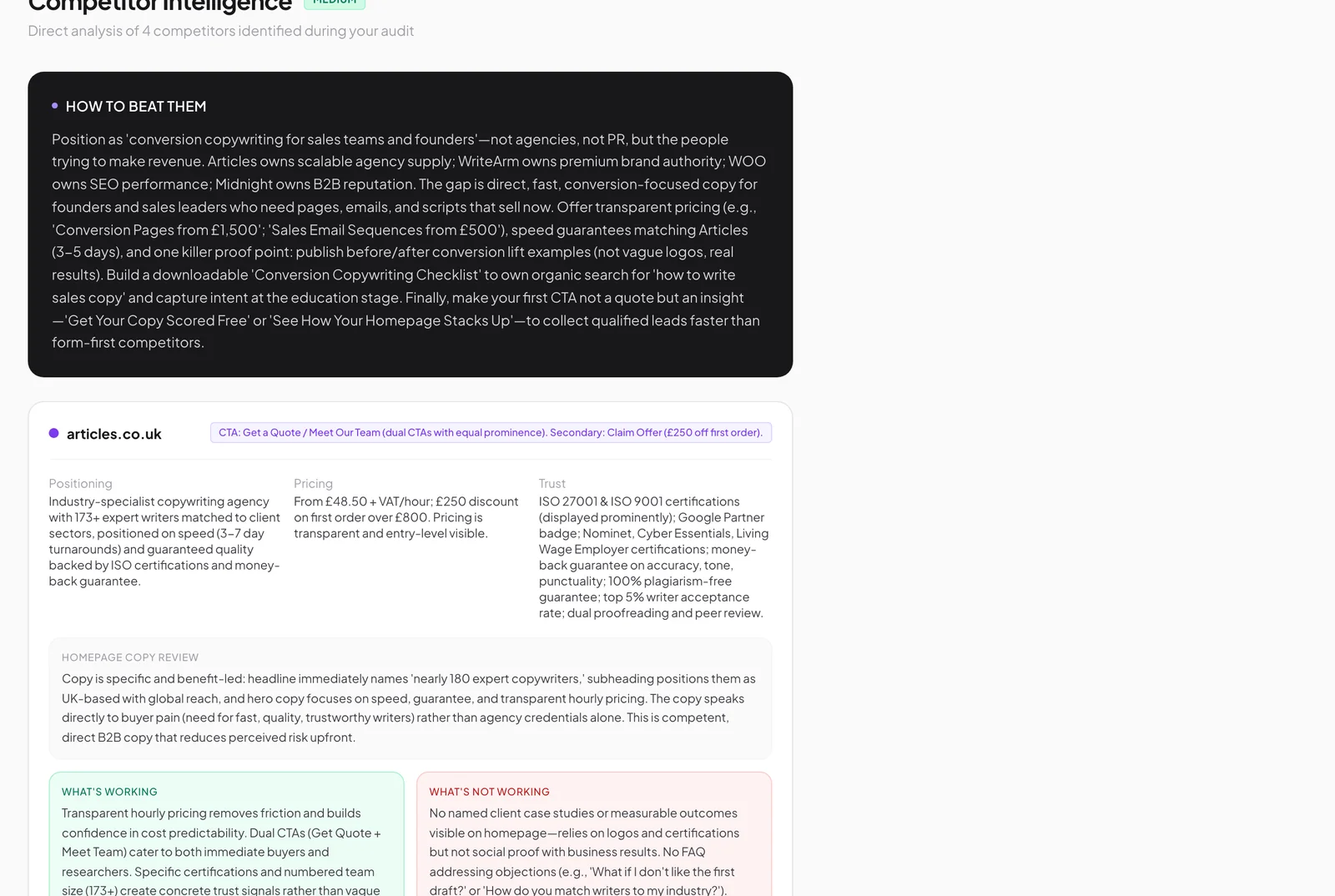
Why it’s £129 and not £9,995
Because every business deserves to know exactly what’s holding it back — and how to fix it — without spending a fortune to find out.
A UK agency will quote £6,000 to £10,000 for this scope — market research, full copy rewrite, site architecture, SEO plan, a content calendar and follow-up emails. You can go and check that; the quotes are easy to get.
The price is low on purpose. The engine I built does the heavy reading — hundreds of real conversations in your market — so you get agency-level work without paying for an agency’s overheads. The work is the same work. The price is a decision about the value you deserve, not a measure of what it’s worth.
It won’t stay here. Work this good isn’t a £129 job for long — it’s going up to £995. If the price still says £129, take it while it does.
Current price £129 · limited-time offer · when it ends, it ends
What you’re not getting for £129
I’m not building the site. This is the document a developer builds from — or that I build from, if you want to talk about that separately.
The £129 doesn’t cover running your ads, your socials or your inbox. I do those — they’re just separate jobs, scoped and priced separately.
And I’m not promising a number. Anyone who tells you a copy rewrite will produce a specific percentage lift is making it up. What I can tell you is what’s currently broken, why, and what the replacement should say.
The maths, out loud
What is this actually worth to your business? Agencies charge £6,000 to £10,000 for the work inside it — the market research, a homepage written to a researched buyer avatar, competitor intelligence, SEO architecture built on real search data, a three-month content plan, a three-email follow-up sequence and Google Ads copy with the keywords to run it against. That’s the job this document does.
It’s going up to £995 — still a fraction of what the same work bills at elsewhere. And right now it’s £129, as a limited-time offer, because the engine I built does the heavy reading — and every business deserves this level of work without an agency’s bill.
And the method isn’t theory — it built the site you’re reading. The research run behind these pages went through 17 million characters of real public conversations in about an hour — one of its biggest runs — built the buyer avatar, and every line here was written to it. Yours gets the same method.
Questions, answered straight
Do I need the free audit first?
No, but it’s the sensible order and it costs nothing. The free audit finds the problems. This one solves them. If you go straight to this, I’ll run the diagnostic as part of it anyway.
How long does it take?
Within 24 hours of payment, usually sooner. The research is the slow part.
Can my developer work from it?
That’s what it’s designed for. It’s written as a build document — copy in order, structure specified, schema written out for them to check and add. It’s a draft to check and personalise, not a finished site.
What if I don’t like the copy?
One round of revisions is included. Tell me what’s wrong and I’ll rewrite it — I’d rather that than have my writing on a site nobody’s happy with.
Is £129 the whole cost?
Yes. One payment, no subscription, nothing recurring, no minimum term.
The fix, in full.
£129
Limited-time offer · going up to £995
Market research, draft copy, site structure, SEO plan, a 30-day action plan, a three-month content plan and a three-email follow-up sequence. Within 24 hours.